
Last time we landed on there being no real job description for a “good academic”.
There’s no one-size-fits all. Which is.. I have to painfully admit, a little bit of “Well duh Simo so what do I even do then?” kind of position to take.
But I took it.
And if nobody tells you what the job is (which is another way to say “academic freedom”, what do you actually do?
First, yes, this is a hill I will gladly die on: Academic freedom is ___ THE PERK ___ of this career. I sell it as such too. But with too much freedom, it’s so easy to get lost. So easy!
“Traveler, your footprints are the only road, nothing else.”
Antonio Machado
In academia, you’re left to create your own future through daily choices and actions.
And what’s the easiest choice always? Copying others. And there’s nothing wrong in copying!!
At least initially, that is.
Copying Works Until It Doesn’t
When you’re starting, copying is the right thing to do. You need to model someone. And best that someone is someone close to you.
Modelling is how humans learn anything complicated. You have a teacher, and you copy. All good.
The trouble starts later. And it starts because you don’t just copy the methods and the universally good stuff.
You copy the style, the rhythm, the taste, the opinions on which venues count, who to trust, which fields are serious and which ones suck. And you inherit the blind spots. You inherit the bad habits, sometimes even without noticing. Every broken mental model they present confidently as “The Way”.
Their path worked. For them. In their time, their environment, their funding, their luck, in a field that isn’t what it was back then.
We all do that, even when it’s plainly clear their word is not the only final final truth.
Most supervirsors, bosses, PIs are doing their honest best though. So please don’t think this is an attack piece of any form.
It’s simply that copying has an expiry date.
Because there’s one thing you must never ever copy.
Their judgement.
Now, the thing to do to avoid copying that is embarrassingly simple but at the same time terrifying.
Start asking different questions. Your questions. Even if it makes you sound…weird.
The Liberation in Being a Bit Weirdo
To be a researcher is to discover knowledge. To discover anything, you need questions.
Your own questions.
And those questions, those that are worth asking, already live somewhere inside you. In your ideas and obsessions. Your irritations. In the tangent you always nudge the lab meeting toward but you present it as a joke to play safe.
“What if they judge me?“
Oh they will.
And that’s good.
Everyone can copy your methods and even your topic. Most likely, there are a lot of people who are better than you in those anyway.
I know many in my own little academic bubble who are better at everything than me. But they don’t have my weird in them. Not even close. Nobody can copy Simo. And nobody can copy you.
Being you is a career strategy when there’s no ready-made path to follow anyway in academia.
The Bill That Comes with the Freedom
If academic freedom is the right to choose, it’s at the same time an obligation to choose well.
And when you choose badly, there’s nobody else to blame. We’re all to blame for our own poor calls. Freedom is terrifying.
Plenty of people stare at it, and turn away. I’ve had people in my team quit because they recognised early on they don’t want to work in a territory with no visible path. No problem with that.
Not having a clear path laid out for them is not for everyone.
You’re Going Wayfinding
Your PhD had a curriculum. Methods, literature, writing, a structure.
It also ideally teaches you something more valuable than that.
Navigating without a map. Or in Moana-terms (yeah we went to see the new one this summer), wayfinding. That’s the hardest and most valuable training in academia.
Done right, and long enough, finding your way around gives you judgement.
Judgement is knowing what matters. In your field and world.
Knowing which question is worth your time and why. Knowing when a result is interesting and not just true. Knowing what is enough.
Nobody can lecture the skill and art of having judgement/taste into you. You earn it by wandering, toiling, sweat and blood, and time.
And there is no shortcut. But we all need it now, more desperately than ever, and faster than ever.
For the robots, they really are coming.
About That Panic Over Jobs
I’m not going to insult you by pretending the market is fine.
Positions are scarce, contracts are short, and “believe in yourself” is worthless advice when funding is 404 and future doesn’t exactly look much better.
Some time ago, you could be very successful by just executing hard. Grinding. Submitting. Drafting text. Writing code, running the analysis. Generating figures. Finding papers to cite. Citing them. Writing more.
I can now have an army of robots do that, very fast, very well.
Looky here: https://simohosio.com/scholark-1 Or looky here: https://simohosio.com/scholark
I pair these with Claude Code, bolt that with Git to Overleaf, and I can bring magic alive in an afternoon. All of it got fast, and it gets faster every month.
If your value proposition was execution speed, I have bad news for you. From a very topical substack:
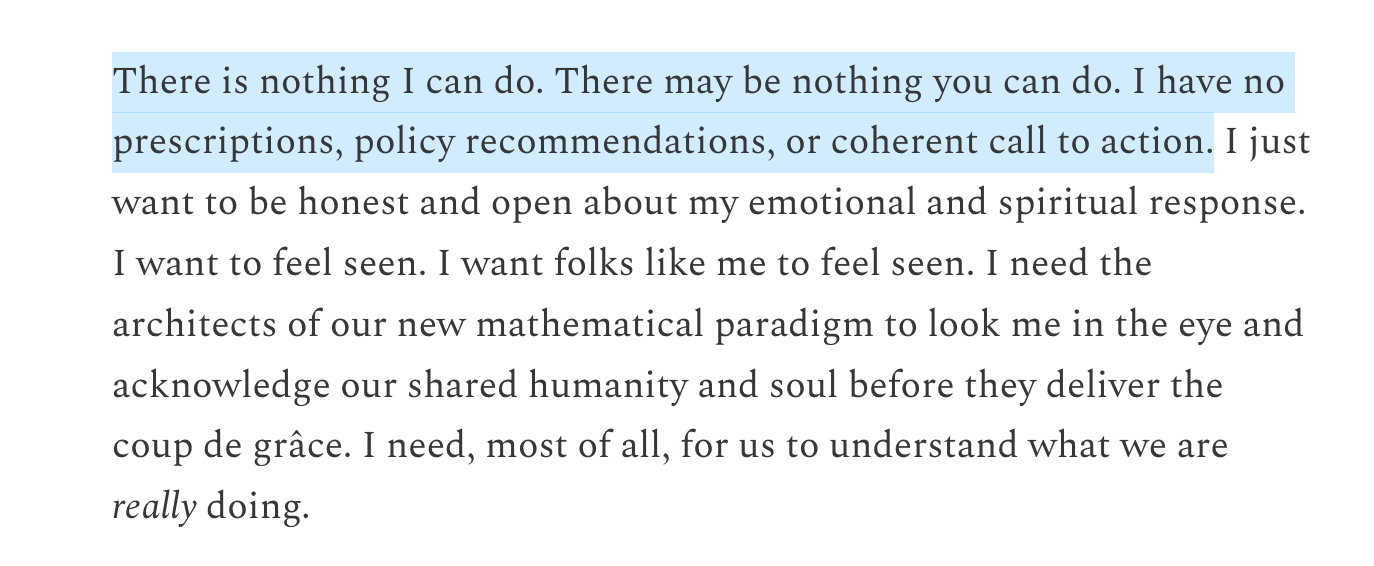
It’s brutal out there now. But what will never go out of fashion is:
- Having good judgement you develop over time
- Being weird enough to ask questions others don’t
- Having the guts to go after the answers (with robotic friends or without)
Yet, AI will cheerfully generate you a hundred plausible research questions this afternoon.
It holds no opinion whatsoever about which one is worth your time.
That call requires judgement, the one thing in this business that got more valuable at the exact same time everything else got cheaper.
There has never been an oversupply of people who can find problems worth solving. Not in any economy, in any century. It survives every technology shift, because noticing a good question requires noticing things that nobody has written down yet. And the courage to look silly.
So, just as a thought exercise, turn off the anxiety for a bit, and look at what’s really happening within.
It’s a question about yourself. Do you believe you can find problems that matter? Indeed, not just “yourself” but in your ability to find problems that together form your unique path.
Finding problems worth tackling can be trained, and it gets trained by the thing many of us already have and keep apologising for.
Freedom, wandering, and years of following your own weird nose.
Define your own version of success. In boring written specifics. Because that’s the only map you’ll ever get.
And just because quotes are a thing, I’ll just leave you with this one from my Momentum Dash today:
“Life shrinks or expands in proportion with one’s courage.”
Anaïs Nin
Courage to be you in a world where execution is a commodity.
That’s your job.